Transfers Between Your Own Accounts: Why Reported Expenses Are Higher Than Actual
Double counting: how to fix the report

You open the monthly report — and it shows 94,000 rubles in expenses. Your salary was 85,000. The logic fails.
Money can’t disappear more than you received. So the report is lying — not because the app is bad, but because some transactions are counted twice. This is double counting, and it almost always happens when you have multiple accounts, a cashback card, a savings account, and a credit card.
Here’s what typically happens in a month:
- Salary arrives on the debit card — recorded as income.
- Part is transferred to the savings account — recorded as expense.
- Cash is withdrawn — recorded as expense.
- Groceries bought with cash — recorded as expense.
- Paid at a restaurant with a credit card — recorded as expense.
- Credit card paid off from debit card — recorded as expense.
Steps 2, 3, and 6 are not expenses. They are money moving within your own pocket. But if recorded as expenses, the total nearly doubles. Here’s how to fix it: criteria, table, case study, and a 10-minute reconciliation.
Why the Brain Confuses Transfers and Spending
Richard Thaler described an effect called mental accounting: people mentally separate money into “wallets” depending on where it is — cash, card, deposit, credit card. Money in a savings account psychologically feels "different" from money on a card, even though it’s the same money belonging to the same person (Thaler, Journal of Behavioral Decision Making, 1999).
The practical takeaway: transferring from a card to a deposit feels like "spent" because the money left the familiar account. The brain signals "minus," the hand reaches to record an expense — and the report starts lying.
Knowing the mechanism doesn’t automatically stop the mistake but helps catch yourself when recording: is this money still mine? Did it just move?
The Main Criterion: Did the Money Leave to Someone Else?
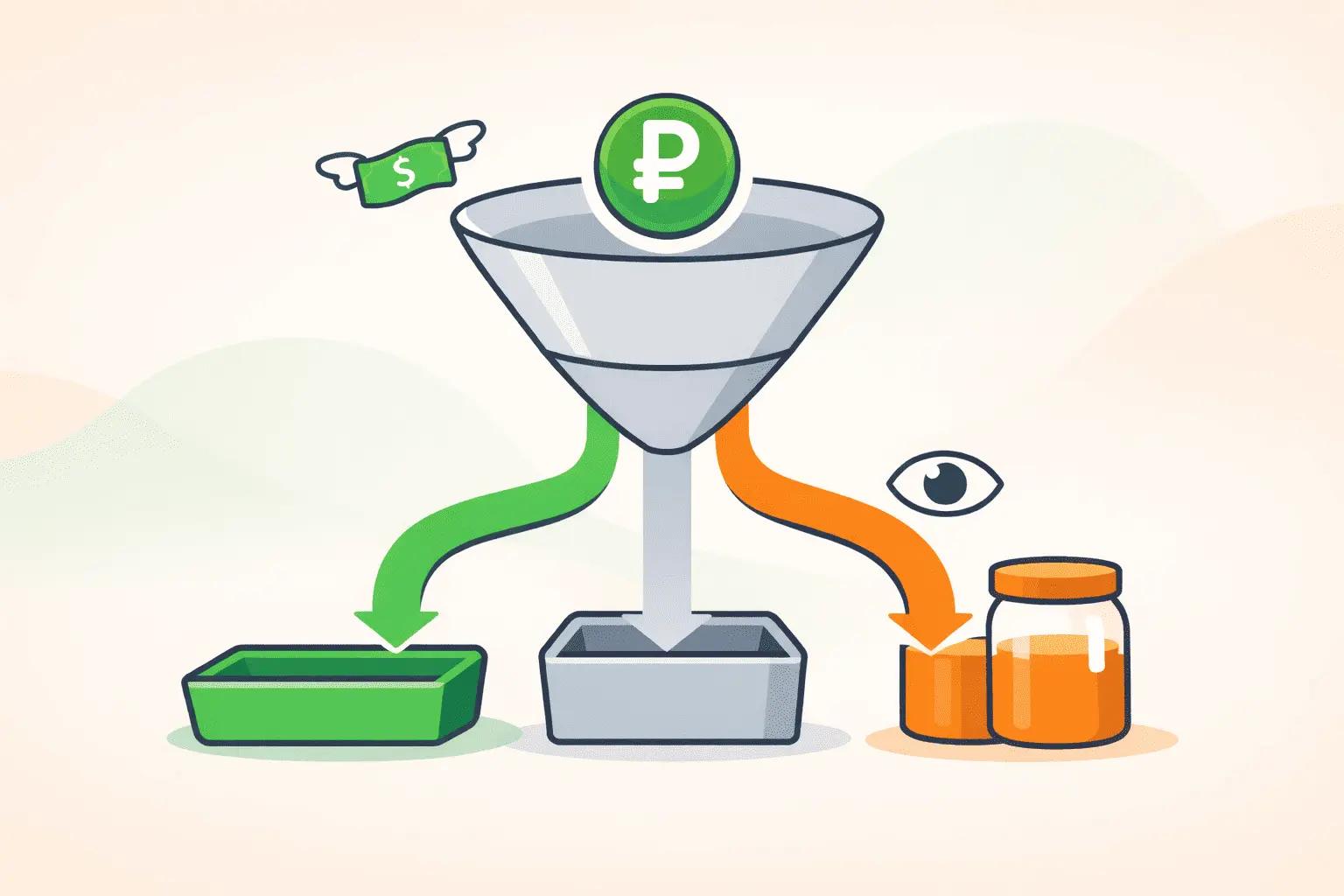
An expense is when money leaves your financial system and goes to an external recipient: a store, service, or person you owe.
A transfer is when money moves between accounts you control.
Simple check: if you can return the money without a third party, it’s a transfer, not an expense.
Withdrawing cash — transfer: money moved from a cashless pocket to cash but remains yours. Expense appears later when you pay cash for something specific. Funding a savings account — also a transfer: money didn’t disappear, just moved.
Paying off a credit card is more complex; we’ll return to it separately.
Note: not every transaction between cards is an internal transfer. If money goes to someone else’s card, that’s an expense (or income for that person). Internal transfer is only between accounts you manage.
Table: What Is What
| Operation | Type | Note |
|---|---|---|
| Transfer from salary card to savings account | Transfer | Both accounts are yours |
| Cash withdrawal at ATM | Transfer | Money moved to "cash" account |
| Grocery purchase with cash | Expense | Money left to the store |
| Credit card payment at a restaurant | Expense | Recorded at purchase time |
| Credit card payoff from debit card | Transfer* | Only if purchases already recorded as expenses |
| Credit card payoff (purchases not recorded) | Expense | Otherwise double counting |
| Product return to card | Expense cancellation | Reduces period expenses |
| Bank commission for transfer | Expense | Separate line, category "Bank" |
| Transfer to your sole proprietor/self-employed account | Transfer | If you keep unified accounting |
| Transfer to another person as debt repayment | Expense or transfer | Depends on your accounting logic |
* More details in the credit card section below.
Mini-Case: A Month with Four Accounts
Alexey has been tracking for six months. Salary — 87,500 rubles. At the end of April, he opened the report and saw expenses of 112,300 rubles. He started investigating.
Here’s what he recorded for the month.
Income:
- Salary to debit card: +87,500
Recorded expenses (as he thought):
- Transfer to savings account: 20,000
- Cash withdrawal: 8,000
- Groceries (cash): 6,400
- Cafes and restaurants (credit card): 9,800
- Transport (credit card): 3,200
- Clothing (credit card): 14,600
- Utilities (debit card): 7,300
- Subscriptions (debit card): 2,100
- Credit card payoff: 27,600
- Miscellaneous (cash): 13,300
Total expenses: 112,300 rubles. Minus 24,800 from salary — an unexplained gap.
Alexey reviewed the list and found three duplicated transactions:
- Transfer to savings account (20,000) — money didn’t disappear, just moved. Not an expense.
- Cash withdrawal (8,000) — money moved to wallet. Actual expenses appeared later: groceries 6,400 and miscellaneous 13,300 are recorded separately. Withdrawal itself is not an expense.
- Credit card payoff (27,600) — all card purchases (9,800 + 3,200 + 14,600 = 27,600) were already recorded as expenses at purchase time. Payoff is debt repayment to the bank from your own pocket. Not an expense.
Total duplicated: 20,000 + 8,000 + 27,600 = 55,600 rubles.
Real expenses: 112,300 − 55,600 = 56,700 rubles.
Balance check: 87,500 − 56,700 = 30,800 rubles remain in the system (20,000 in savings, some in wallet, rest on cards). Everything matches — money didn’t disappear.
Note: Alexey wasn’t wrong about how much he spent. He was wrong about what he counted as an expense. These are different things — with different consequences for the report.
If you have a similar picture but can’t understand what the real expenses are, start with a basic spending analysis, then fix transfer logic: /posts/where-money-goes.
Borderline Cases: Where Mistakes Are Easy
Credit Card Payoff
The most common source of confusion. The rule here isn’t absolute — it depends on your accounting approach.
Approach 1 (recommended): expense at purchase time. You buy something with a credit card — immediately record the expense. When you pay off the debt at month-end, it’s a transfer from debit to credit card. No expense, just money moved.
Approach 2: expense at payoff time. You don’t record credit card purchases during the month, but enter the total as one expense at payoff. Then payoff is an expense. But you can’t record individual purchases separately, or double counting is inevitable.
Both approaches work. The only fatal mistake is mixing them in one month.
Important: If you switch approaches mid-month, check the transition period for duplicates.
Bank Commission for Transfer
Commission is not part of the transfer. It’s a separate real expense: money left the bank, not you.
Transferred 10,000 rubles and the bank charged 50 rubles commission — correct recording:
- Transfer: 10,000 (internal)
- Expense "Bank services": 50
Recording 10,050 as expense is wrong — double counting again. Likewise, attributing commission to internal transfer is incorrect; it must always be a separate line.
Purchase Return
Money returned to the card — this is not income in the full sense. It’s an expense cancellation.
Best practice — reduce the original expense amount or create a negative transaction in the same category. Recording the return as "income" inflates both income and expenses for the month — both numbers become incorrect.
If the app doesn’t allow editing past entries, create a separate "Return" transaction in the same expense category with a negative amount. The total remains accurate.
Personal and Business Account
If you have a sole proprietor or self-employed account — it’s your account but with different accounting logic.
Transfer from personal to business account (or vice versa) is internal only if you keep unified accounting for personal and business finances in one system. With separate accounting, transfer from personal to business is an expense for personal budget (and income for business), and vice versa.
There is no single correct scheme here. The key is to choose one and not change it mid-month.
How to Fix the Report If Errors Are Already There
Found double counting over several months? No need to redo everything from scratch.
- Find transactions like "transfer to own account" and "cash withdrawal" recorded as expenses. Usually visible by categories — "Transfers," "Cash," "Savings."
- Check each: are there real expenses from this money in the same period? If yes — delete the duplicated transfer entry.
- For credit cards, choose one approach (record at purchase or at payoff) and ensure you didn’t apply both simultaneously.
- Recalculate totals: income minus real expenses should match the total balance change across all accounts.
- If it matches — the report is honest. If not — look for another duplicated transaction or missing income.
Thought: Balance reconciliation is not an accounting ritual but a way to ensure report numbers reflect reality, not a parallel universe.
When a Transaction Is Both Transfer and Expense
It happens. You transfer money to a friend — part as debt repayment (transfer), part as a gift (expense). Or you fund a joint family account — part for shared expenses, part for savings.
In such cases, split the transaction into two records instead of forcing everything into one line with the wrong type. It takes 20 seconds but keeps report accuracy for months.
If splitting is inconvenient — choose the dominant type and leave a note in the transaction comment. The worst solution is "I’ll sort it out later."
Checklist: 10-Minute Report Reconciliation
Once a month, after closing the period:
- Record balances on all accounts at the start and end of the month (cards, cash, savings, credit card — with minus sign).
- Check transfers between your own accounts — they should not appear in the expenses column.
- Check cash withdrawals — these are transfers to "cash" account, not expenses.
- Find credit card payoffs — ensure purchases are not recorded twice.
- Check returns — they reduce expenses, not increase income.
- Calculate control sum: ending balance = starting balance + income − expenses.
If the control sum is off by more than 500–1,000 rubles — there is a duplicated or missing transaction. Start searching among transfers and cash withdrawals — errors live there most often.
This principle also helps avoid unexpected negative balances — when you look at real balances, not inflated report numbers: /posts/avoid-negative-balance-debt.
How to Avoid Mistakes Next Month
Several rules that work in reality, not just on paper.
Create a separate "cash account." ATM withdrawals are transfers to this account, cash purchases are expenses from it. Then cash doesn’t disappear from accounting or get double counted.
Fix one approach for credit cards. The easiest is to record expenses at purchase time — then payoff is always a transfer, avoiding confusion.
Record commissions separately. Use category "Bank services" for all: transfer fees, card maintenance, SMS notifications. Amounts are small but real expenses.
Spend two minutes weekly checking transaction types. Not categories, but types: transfer or expense? A short Sunday ritual saves an hour of month-end review.
If you’re just building category structure for multiple accounts, start with basic accounting logic before complicating transfers: /posts/digital-ruble-qr-budget-tracking.
Nuance: Perfect accounting is not error-free, but one where errors are immediately visible and easy to fix. The control sum at month-end is exactly such a tool.
A financial report answers one question: where did the money really go? If it shows more than you earned, don’t panic. Spend 10 minutes finding where money was counted twice. Usually, it didn’t disappear — it just moved.
Do This Today
- Open last month’s report and find transactions labeled "transfer" and "cash withdrawal" — check if they are recorded as expenses.
- Record current balances on all accounts — this is the starting point for next month’s reconciliation.
- Decide now: credit card expenses recorded at purchase or payoff — and stick to one approach.
- Create a "Bank services" category and move commissions from past entries there.
- Review returns for 2–3 months: do they reduce expenses or inflate income? Fix if needed.