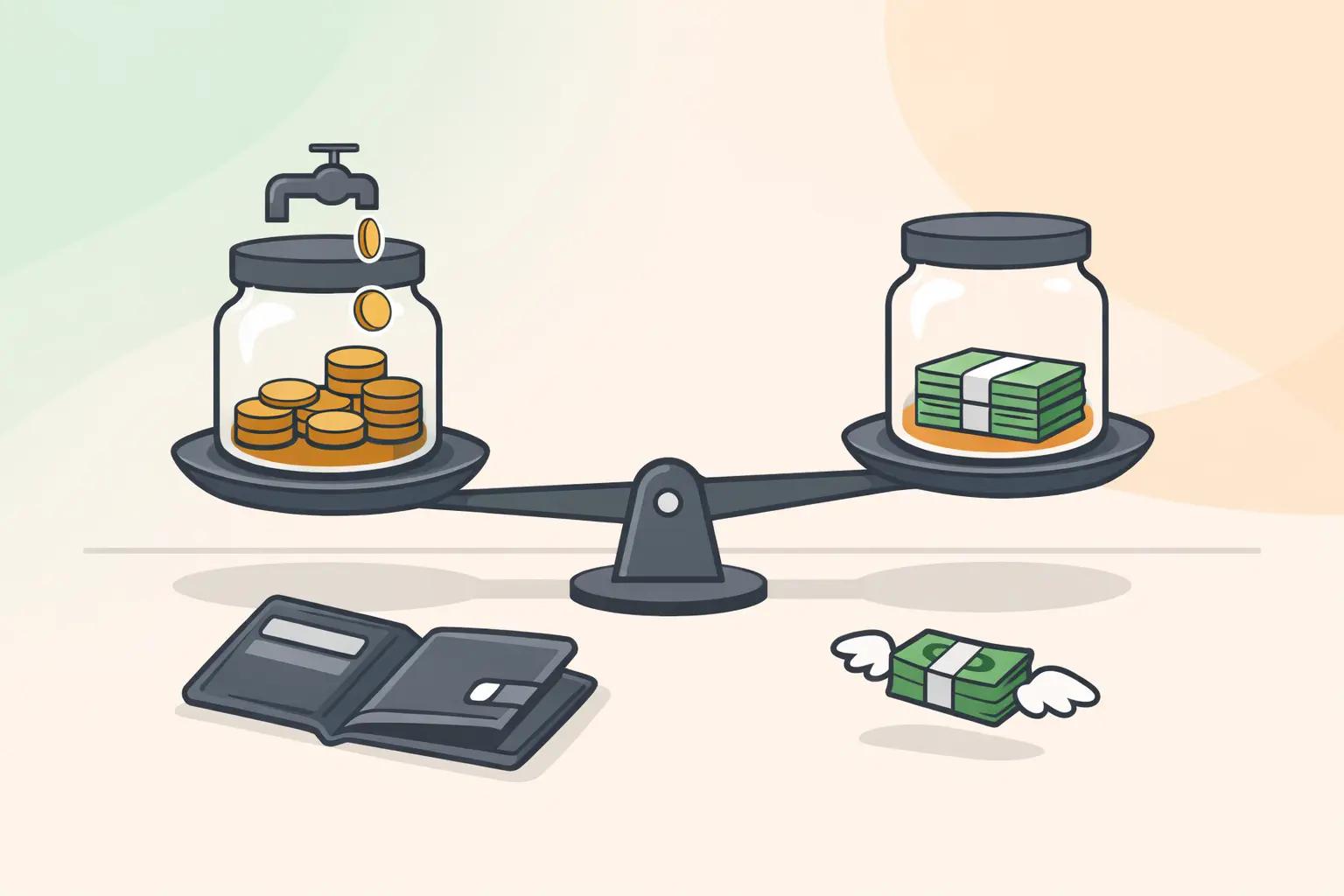

To-go coffee is one of those expenses that barely registers. One cup feels like “nothing,” but a couple of months later you’re staring at a total that could’ve covered something real.
Here’s a quick scale check: a ~$2.89 average cup, bought 4 times a week, is about $603 a year ($2.89 × 4 × 52). No guilt—just a number that makes the habit visible.
The point: habit cost = price × cups per week × weeks per year.
- Get your average cup price (look at your last ~10 coffee buys).
- Count how many cups you had in the last week (or last 2 weeks for accuracy).
- Multiply by 52 (or by your real number of “typical” weeks).
- Separately tally add-ons—those often change everything.
- Pick one lever: frequency, price, format, or “extras.”
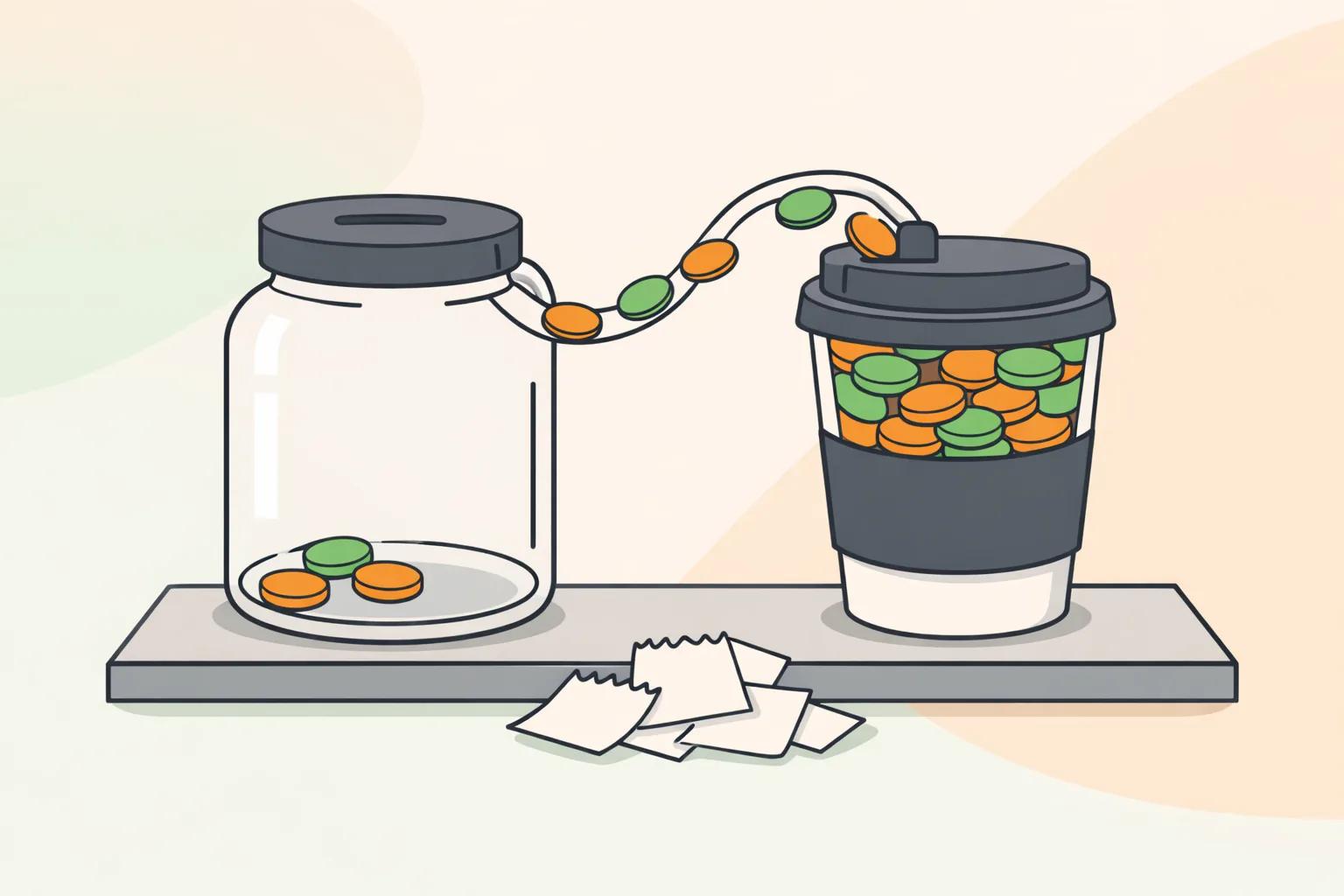
A quick calc for any schedule
To avoid “one size fits all,” there are two easy ways to count. Use whichever matches your life.
Method 1: start from your week
The most universal option: take your last typical week and multiply by 52. If you travel, take vacations, or your routine is seasonal, use your real number of “normal” weeks.
Method 2: quick scenarios
If you want a fast estimate, these scenarios help. They’re not a rule—just a shortcut.
| Scenario | Cups per year | How it’s counted |
|---|---|---|
| Weekdays only | 5 × 48 = 240 | workdays × working weeks |
| Office 3 days | 3 × 48 = 144 | office days × working weeks |
| Every day | 7 × 52 = 364 | days per week × 52 weeks |
Remote work, shift work, weekends—just convert your pattern into “cups per week,” then multiply by weeks.
Two examples to see the order of magnitude
To keep this from turning into a city comparison, here are two different average prices: $2.95 and $3.32. Plug in your own number and everything scales linearly.
- Example A: $2.95, 5 cups/week → about $767/year (~$64/month).
- Example B: $3.32, 5 cups/week → about $864/year (~$72/month).
A second cup isn’t “a little extra.” For a steady habit, it’s often close to doubling the total.
Mini case: when “sometimes” becomes four digits
Evan was sure he bought coffee “once in a while.” He opened his card statement and found a single week like this: Mon $3.02 (late, grabbed the closest place), Tue $2.74, Wed $3.24, Thu $3.40 (different shop because of traffic), Fri $3.15, Sat $3.57 (out with his kid), Sun $2.95. Two times he paid cash and only remembered later—so he had to add them from memory.
That week totaled $22.07. If a week like that repeats most of the year, it’s about $1,148/year ($22.07 × 52). Even if you only have that pattern for ~44 “normal” weeks, it’s still roughly $972/year.
If this is the kind of “small stuff” that causes friction at home, it helps to agree on a tracking model first. A simple hybrid setup often solves the argument better than willpower: shared, separate, or hybrid.
Where the money hides: add-ons and “coffee plus”
Coffee rarely comes alone. Syrup, pastry, bottled water, “grab one for someone else”—the total can shift not by 10%, but by a whole new tier.
Example: a $2.89 cup plus a $2.20 pastry just twice a week is about $530/year ($5.09 × 2 × 52). In that pattern, the add-ons nearly match the coffee.
Practical trick: track “coffee” and “extras” as separate buckets. When they’re merged into one line, it looks like “coffee is expensive,” when it’s often the ritual around it.
How to find coffee in your statement when categories are messy
A 5–7 minute “three pass” search is usually enough.
- List your places. Write down 3–8 merchant names where you often buy coffee (cafés, bakeries, gas stations, kiosks).
- Filter by merchants. In your statement (or exported CSV), filter transactions by those names. If you also buy full meals there, move to step 3.
- Filter by amount and time. Pull transactions under about $5–$6, then look at morning and mid-day purchases. Coffee tends to repeat at similar amounts and times.
Cash purchases and “I paid for a friend” will blur the picture—normal. Add one line called “coffee (cash)” and estimate how often it happens per week. You don’t need perfection; you need the scale.
Deals, cashback, and subscriptions
Discounts only help in one case: you would’ve bought the same coffee at the same frequency anyway. Otherwise, they just reinforce the habit.
A quick break-even check:
- if a subscription saves you S dollars per cup,
- and costs P dollars per month, then it’s worth it only if you buy more than P / S cups monthly.
One more nuance: discounts often make the “second cup” feel easier. After a week with a deal, compare not your cup price, but your purchase frequency.
Home/office vs to-go in real dollars
This comparison only works in your reality. Home coffee can be cheap—or it can become a hobby with gear.
A no-drama method:
- estimate how many cups you actually get from your beans/capsules and milk;
- compute your real cost per cup at home/office;
- compare to your to-go average and multiply by your frequency.
Scale check: even a $2.07 per-cup difference at 5 cups/week is about $537/year. If you “move” only half your purchases, it can still be noticeable.
Price creep: projecting next year
Coffee prices rarely jump in one clean step. Sometimes it’s +$0.25, sometimes the cup size changes, sometimes an add-on quietly becomes the default.
To estimate next year, a simple formula is enough: next year ≈ this year × (1 + price growth).
Example: a current yearly total of about $827 becomes about $909 with a 10% increase—even if your frequency stays the same. This matters when you’re planning goals or making room in the budget: financial goals for 1, 3, and 5 years.
What to tweak so the habit sticks
One lever at a time is the “no guilt” strategy. Most plans fail when you try to change everything in a week.
- Frequency: choose a weekly cap for to-go coffee and keep 1–2 buys as “on purpose,” not “by default.”
- Price: pick one or two reliable spots and avoid the “first place I see” purchase—it’s often the priciest.
- Format: replace one buy with home/office/thermos only if it’s easier than buying.
- Extras: decide separately how often you’ll do pastry/syrup. That’s the quiet multiplier.
Do this in five minutes
- Find your coffee total from the last week in your statement.
- Multiply by 52, then multiply by 0.85–0.9 if you have vacations or strong seasonality.
- Estimate your weekly “extras” total and run the same math.
- Pick one lever for next week: one fewer buy, one cheaper buy, or one buy in a different format.
- Save the yearly number—it explains “why this matters” better than motivation ever will.
The win isn’t “quit coffee.” It’s making the habit visible and adjustable. When you run the math, does your number feel like “fine” or “whoa”?
FAQ
Use a recent typical week: total cups and total spend. Multiply by 52. If you have vacations or seasonality, multiply by your real number of weeks instead.
Start with merchant names you recognize, then filter by smaller amounts and morning-time purchases. Estimate cash buys separately by frequency; you only need the scale, not perfect precision.
Frequency usually wins. One extra purchase per week adds up fast over a year. Price differences matter, but they show up mainly when the habit is truly regular.
It’s only a win if you’d buy the same number of coffees anyway. Check break-even: monthly savings from discounts must exceed the subscription price; otherwise it just nudges you to buy more.