
One month you receive ₽140,000. The next — ₽55,000. Meanwhile, expenses remain roughly the same: rent, food, transport, communications, loans.
This is where most attempts to budget with irregular income fail: people base their spending on a good month, then a weak month hits their account like a surprise. But there’s no surprise — there was simply no system.
The effective approach is different: base your budget on the minimum, not the maximum. Know your fixed expenses upfront. Allocate money weekly, not "roughly by month." Keep a cash buffer for weak months. And separately account for anything outside your usual rhythm: taxes, bonuses, large one-time inflows.
Below is a step-by-step scheme that makes life easier for freelancers, self-employed, professionals with bonuses, and those with seasonal income.

Step 1. Find Your Fixed Minimum
Budgeting with irregular income starts not from income but from expenses: how much you need just to live each month without extras.
Fixed expenses include:
- rent or mortgage;
- utilities;
- basic groceries;
- transportation to work/errands (commute pass, fuel, car sharing);
- communications and internet;
- essential subscriptions needed for work (e.g., design software or cloud storage);
- loans and other fixed obligations.
Add these up. This number is your monthly fixed minimum. It’s the amount you must cover every month, even if income falls short.
If you haven’t detailed your expense categories yet, it’s helpful to start by setting them up — how to do this in accounting. Clear categories help distinguish “fixed” from “nice to have.”
An unstable salary isn’t dangerous if you know: “I need at least ₽63,000 to live; everything else depends on the situation.”
Step 2. Base Your Budget on a Conservative Income
The problem with variable income is usually not how much you earn, but which figure you base your budget on.
A common scenario: a month with ₽140,000 sticks in your mind as the “new normal,” and all plans revolve around it. In a weak month (₽55,000), the budget doesn’t add up, causing cash flow gaps: money is needed, but income isn’t coming.
What to do if your income varies monthly:
- Take your income for the last 6–12 months (the more data, the better).
- List all monthly amounts.
- Remove 1–2 highest months — bonuses, big projects, seasonal peaks.
- Calculate the average of the remaining months — this is your conservative average income.
- If income fluctuates widely (2–3 times or more), also note the minimum income during this period.
Now you have two useful figures:
- conservative average income — the basis for budgeting with irregular income;
- minimum income — a “worst-case” plan if you want maximum protection.
Why not use the best month:
- you’ll spend “like in the best month”;
- but live “like in the worst.”
Best months are a bonus, not a baseline. Their role is to feed your buffer and goals, not raise your regular living standard.
Rule: build your budget from the conservative income. Anything above it is not “free money” but material for your buffer and goals.
Step 3. Break the Month into Weeks
Even if you estimate a monthly budget with variable income, it’s still hard for your brain to stick to it daily.
Example: you set a limit of “₽30,000 for everything except fixed expenses,” and by the 18th you realize “I spent too much on cafes and delivery,” but don’t want to recalculate.
A weekly limit solves this:
- Take the amount you’re willing to spend monthly on variable expenses: eating out, cafes, clothes, cosmetics, entertainment, small purchases, spontaneous treats.
- Divide it by 4 or 4.5 (whichever suits your week counting).
- Get your weekly limit — a number easy to keep in mind.
For example:
- conservative income: ₽85,000;
- fixed minimum: ₽60,000;
- variable expenses left: ₽25,000;
- weekly limit — about ₽6,000.
No longer “however it goes monthly,” but a clear “about six thousand per week.”
Why a weekly limit helps with variable income:
- shortens planning horizon to a manageable unit;
- easier to spot overspending (“we’re already negative this week”);
- simpler to adjust: if you’re ahead now, tighten next week a bit.
For more on spending stability, see monthly spending predictability.
Step 4. Build a Buffer for Weak Months
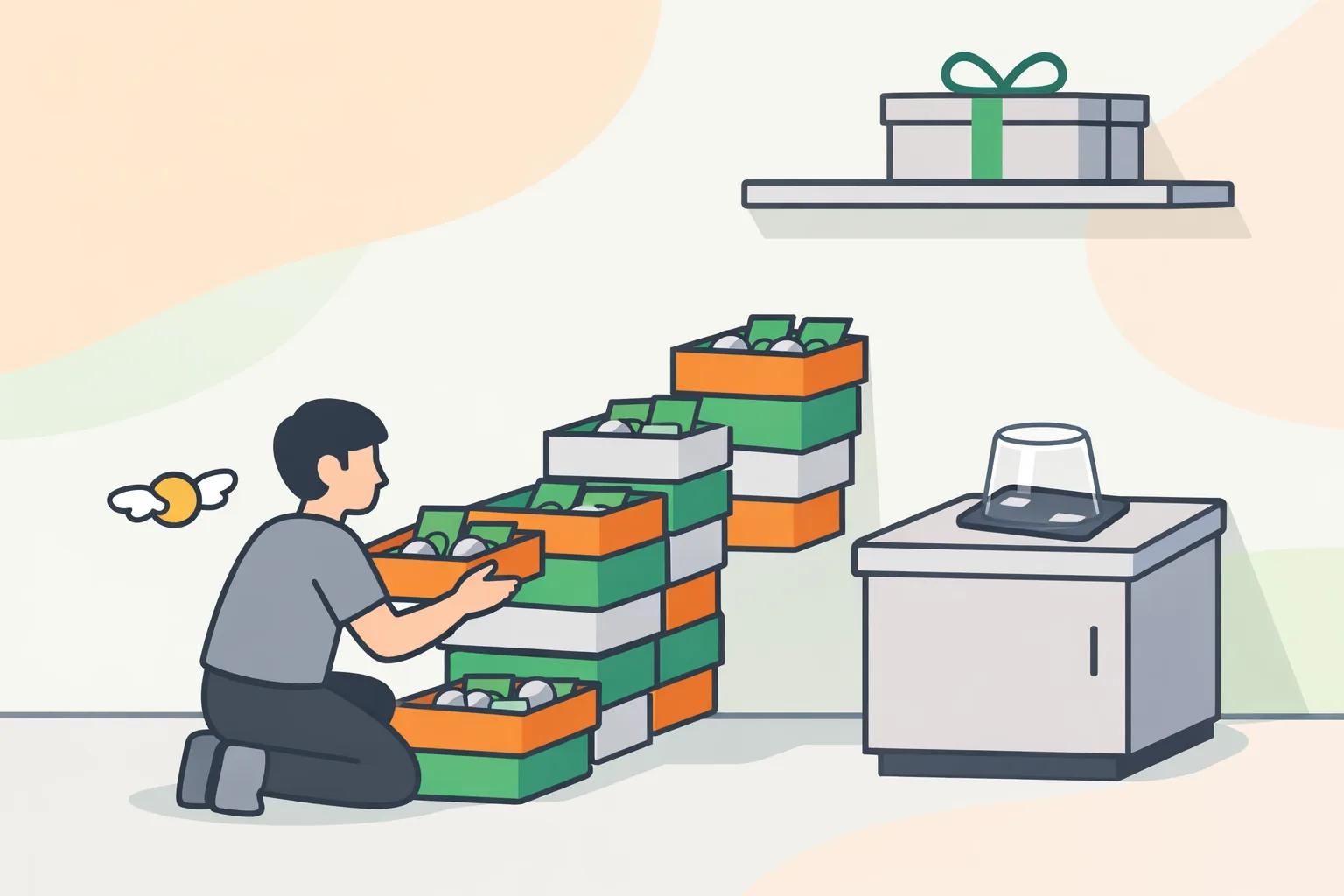
With irregular income, a buffer isn’t a luxury. It’s a way to shift money from strong months to weak ones.
It’s important to distinguish two types of reserves:
- emergency fund — for unforeseen events (illness, equipment breakdown, urgent move);
- cash buffer — for predictable income fluctuations (seasonality, order drops, payment delays).
Here we focus on the buffer.
Buffer goals with variable income:
- minimum — 1 month of fixed expenses;
- comfortable — 2 months of fixed expenses;
- if income is very volatile or seasonal — aim for 2–3 months.
So if your fixed minimum is ₽60,000, your buffer should be between ₽60,000 and ₽120,000.
How to fill the buffer:
- determine your conservative income (e.g., ₽80,000);
- allocate everything above it into parts:
- portion to buffer (e.g., 30–50%);
- portion to goals (vacation, equipment, moving);
- a small part to “treat yourself” so the system doesn’t feel like a hardship.
Example:
- strong month income: ₽140,000;
- conservative income for planning: ₽80,000;
- difference: ₽60,000;
- from this ₽60,000:
- ₽30,000 to buffer;
- ₽20,000 to goals;
- ₽10,000 to extra spending this month.
Keep the buffer separate from your main account: a separate account or piggy bank. Not for aesthetics, but because money “all in one place” almost always gets mixed up.
For more on long-term emergency funds, see emergency fund and its size. Even a small buffer covering 1–2 months of fixed expenses drastically reduces cash flow risks.
Note: the buffer shouldn’t be “fragile.” It’s okay to use it in weak months. The key is not to blame yourself but to replenish it in strong months.
Step 5. Account for Taxes and One-Time Inflows Separately
People with irregular income often face two common sources of chaos:
- taxes;
- large one-time inflows (bonuses, big projects, debt repayments).
Taxes with Variable Income
If you’re self-employed, an individual entrepreneur, or working as a private person, tax is not a “future issue” but an existing expense.
Simple principle:
- Money arrives in your account.
- Immediately set aside the tax portion (4–6% for self-employed, or your applicable tax rate).
- Transfer this amount to a separate “Taxes” account.
- Don’t include it in your regular budget.
This way, you don’t spend money that isn’t yours and avoid cash gaps like “I need to pay taxes but have no money.”
Large One-Time Inflows
Bonuses, one big seasonal project — these create the illusion of “life got easier” if you immediately include them in regular spending.
With unstable income, it’s safer to treat such money as a separate event:
- Money arrives.
- Decide how to allocate it:
- to buffer (support weak months);
- to goals (vacation, equipment, repairs, education);
- to one-time treats you’ve long wanted.
- These sums do not go into your regular monthly budget. They are one-offs, not regular income.
If you just “spread” a large payment over the current month, by the end you won’t remember where it went. More importantly, it won’t work to strengthen your financial stability.
Mini Case: Six Months, One Calculation
Marina is a freelance marketer. Her income over six months was:
| Month | Income |
|---|---|
| January | ₽59,800 |
| February | ₽114,200 |
| March | ₽77,600 |
| April | ₽142,300 |
| May | ₽64,900 |
| June | ₽91,400 |
At first glance, “all normal, about ₽100,000 on average.” But the average doesn’t help here.
- Remove the best month — April (₽142,300).
- Calculate the average of the remaining five months:
(59,800 + 114,200 + 77,600 + 64,900 + 91,400) / 5 ≈ ₽81,200.
This is her conservative average income.
Marina’s fixed expenses:
- rent — ₽33,000;
- basic groceries — ₽15,200;
- transport and taxi — ₽5,100;
- communications and internet — ₽1,900;
- laptop loan — ₽8,700.
Total fixed minimum: ₽63,900.
Variable expenses left:
81,200 − 63,900 = ₽17,300 per month.
Divide by weeks:
17,300 / 4 ≈ ₽4,300 per week for cafes, clothes, small purchases, and entertainment.
Now look at two extreme months.
April — Strong Month
Income: ₽142,300.
- Tax as self-employed (6%) — ₽8,538 → immediately to a separate tax account.
- Personal budget gets ₽81,200 (conservative income).
- Difference: 142,300 − 8,538 − 81,200 ≈ ₽52,562.
Marina decides:
- ₽30,000 to buffer for weak months;
- ₽15,000 for autumn vacation;
- ₽7,562 for “wants” outside the usual weekly limit.
January — Weak Month
Income: ₽59,800.
- Tax 6% — ₽3,588 → tax account.
- Remaining ₽56,212.
Her fixed minimum is ₽63,900. There’s a cash gap of ₽7,688, not counting variable expenses and small items.
Without a buffer, this would mean:
- stress;
- borrowing from friends;
- or credit card debt that’s hard to escape.
With a buffer, it’s different:
- ₽63,900 for fixed expenses is partially covered by current income;
- the missing ₽7,688 plus two weeks of variable expenses (2 × ₽4,300) she calmly takes from the buffer.
No panic, no “where to get money.” The weak month was planned for.
Previously, Marina splurged in good months: expensive restaurants, spontaneous tech purchases “since the project went well.” In bad months, she went negative or dipped into savings “for the future.” After she:
- calculated her fixed minimum;
- identified conservative average income;
- set a weekly limit;
- and built a buffer,
variable income stopped meaning variable stress.
Why Uncertainty Impairs Thinking
Behavioral economics and psychology research show: financial uncertainty increases stress and narrows focus. When you don’t know “if you’ll make it to the end of the month” or “what will happen next,” your brain switches to survival mode.
In this mode:
- planning becomes harder;
- decisions become more impulsive;
- we prefer “small gain now” over “steps for the future.”
This isn’t about “weak discipline.” It’s how the brain works. That’s why with variable income, a system replaces willpower. When you have:
- a known fixed minimum;
- a conservative income;
- a weekly limit and cash buffer,
the uncertainty level drops. Along with it, it becomes easier to:
- refuse unnecessary expenses;
- make decisions on new projects and orders;
- plan big purchases and vacations.
Thought: control is not rigidity but clarity. Variable income itself isn’t scary; only the fog around it is.
Common Mistakes with Variable Income
1. Planning based on the best month.
“If I earned ₽130,000 in March, I can comfortably live on ₽100,000 always.” Over time, this almost guarantees cash gaps, especially with seasonal swings.
2. Not separating taxes.
Self-employed and entrepreneurs often see incoming payments as full income. Taxes are “somewhere ahead” and not counted as current expenses. When tax payments come, they have to dip into buffers, loans, or borrow.
3. Mixing buffer with current money.
“I have a reserve on my card but won’t touch it” rarely works — because we’re human. A separate account or piggy bank prevents unnoticed depletion.
4. Ignoring seasonality.
If for two or three years in a row:
- January and August are weak;
- October and December are strong;
this is not a coincidence but an income pattern. Seasonality isn’t an enemy if accounted for. In strong months, you consciously feed the buffer; in weak months, you live off it.
5. Tracking only expenses.
Freelancers and self-employed often carefully record expenses but not every income: source, reason, date. Without this picture:
- you can’t see your real minimum and average income;
- it’s hard to spot payment delays;
- it’s difficult to understand which clients and projects stabilize your income.
If you often feel “money is never enough,” it’s useful to review income — see more in the chronic money shortage article.
Different Situations: How to Adapt the System
No scheme must work “the same for everyone.” It’s important to tailor it to your reality.
Very Unstable Income
If you have:
- ₽40,000 one month;
- ₽160,000 the next;
- then ₽70,000;
with a 3–4 times or more range, be conservative:
- base your budget on the minimum income over 6–12 months;
- set a very modest weekly limit;
- aim for a buffer of 2–3 months of fixed expenses.
The goal is for weak months not to be a problem and strong months to comfortably feed buffer and goals.
Couple or Family: One Stable, One Variable Income
If one partner has a fixed salary and the other variable income:
- stable income covers fixed expenses and some basic variable costs (food, transport);
- variable income goes to additional variable expenses, goals, and buffer.
This way, freelance cash gaps affect the family less: basics are covered by salary.
Seasonal Income
Typical for photographers, guides, tutors, seasonal specialists. Half the year is busy, half quieter.
Logic here:
- treat annual income as a whole;
- divide by 12 to get an average monthly spending guideline;
- consciously increase buffer contributions during peak seasons;
- know which months will be weak and avoid “living like it’s peak season.”
Just Starting Accounting
If you’ve never tracked finances and “counting everything for 12 months” feels overwhelming:
- Start with one step: write down your fixed monthly expenses.
- For the next 1–2 months, simply record:
- every income (with date and source);
- every expense (at least by major categories).
- After 2–3 months, you’ll have a rough conservative income to work with.
If you want a foundation for stabilizing spending and avoiding living paycheck to paycheck, see monthly spending stability.
Tip: if the system feels like a “new marathon,” it won’t last. Better a simple scheme you can maintain for years than a perfect budget that breaks in two weeks.
Checklist: Set Up Accounting for Irregular Income
Here’s a compact plan you can complete in a couple of evenings and refine over time.
- List fixed expenses. Write down rent, utilities, basic groceries, transport, communications, loans, and other fixed payments. Calculate your monthly fixed minimum.
- Gather income data. Record income for the last 6–12 months: amounts and months. Remove 1–2 highest months, calculate conservative average income, and note the minimum.
- Set budget limits. Subtract fixed minimum from conservative income. Divide the remainder into monthly and weekly variable expense limits. Check if the resulting number requires too strict saving.
- Create a separate buffer account. Decide your buffer size (1–2 months of fixed expenses). From each income above the conservative level, allocate a portion to it until the goal is reached.
- Separate taxes from personal money. Open a separate tax account and immediately set aside the required percentage from each payment. Don’t include tax money in your spending budget.
- Set up income and expense tracking. In any convenient system (including Kopium), create categories for fixed and variable expenses, mark accounts for buffer and taxes, record each income with source and amount — this provides a basis for analysis and adjustments.
Irregular income doesn’t have to mean an irregular life. If you know your minimum, budget from conservative income, and keep a buffer, weak months stop being a disaster and become just part of your financial weather.