

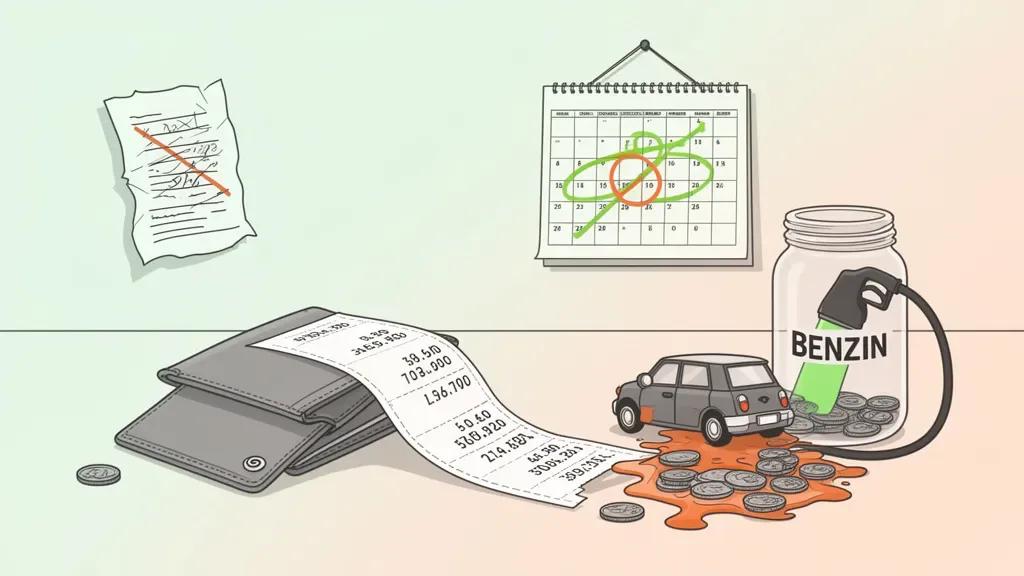
Filled up the tank, looked at the receipt — and something doesn’t add up. The total is the same as a month ago, but the tank isn’t full. Or it’s full, but you spent 600 rubles more.
This isn’t just a feeling; it’s a real shift in the budget. Most families notice it after the fact: by the end of the month, there’s not enough for something else, and it’s hard to figure out where the money went.
The good news is that transport is one of the few categories where price increases can be calculated precisely, not guessed. Here’s a quick plan: gather actual mileage for 2–3 months, calculate fuel costs using a formula, compare with the current limit, separate seasonal trips, and include a small buffer. We’ll break down each step below.
Symptom: money is spent, but mileage stays the same
The usual scenario: a family used to spend about 6,500 rubles a month on gasoline, drove the same amount as before — but now it costs 7,800–8,200 rubles. No new routes, no change in habits.
The difference is the price increase.
According to Rosstat’s retail price monitoring, the average price of AI-95 gasoline in Russia at the start of 2025 was around 56–58 rubles per liter depending on the region. A year earlier, AI-95 cost 3–5 rubles less on average.
That sounds small. But over a month, it adds up.
Why the usual limit stops working
Many families set a transport limit once and don’t adjust it for years. The logic is clear: mileage is roughly the same, the car is the same, why recalculate?
The problem is the limit was calculated at the old price. When the price per liter rises, the limit automatically becomes underestimated — even if you drive less.
Three reasons why this goes unnoticed:
Category blur. Transport often appears as a single line: gasoline, parking, car wash, sometimes taxi — all together. When fuel prices rise, overspending hides within the total.
Irregular refueling. Refueling every 10–12 days means some months have 2 fill-ups, others 3. The number fluctuates even if mileage is the same.
Seasonal trips excluded. Country house visits, trips to relatives, car vacations — separate expenses rarely included in the base limit.
Fuel price is precisely calculable. Fuel is one of the rare cases where price increases are immediately visible and calculated without guesswork.
How to calculate actual monthly fuel expenses
The formula is simple. You need three numbers.
- Monthly mileage — compare the odometer now and a month ago, or take the average over 2–3 months.
- Fuel consumption — official or actual. Actual city consumption is usually 10–15% higher than official.
- Price per liter — current price at your usual gas station.
Calculation:
Mileage (km) × consumption (l/100 km) ÷ 100 × price (rub./l) = monthly fuel expenses
Example for Moscow, July 2025:
- Mileage: 1,400 km
- AI-95 consumption: 9.5 l/100 km
- Price: 57.5 rub./l
1,400 × 9.5 ÷ 100 × 57.5 = 7,648 rubles
The same calculation at last year’s price — 53 rub./l:
1,400 × 9.5 ÷ 100 × 53 = 7,049 rubles
Difference — 599 rubles per month, or about 7,200 rubles per year, just due to price, without extra kilometers.
What to do with this number
This isn’t a reason to worry but to adjust the limit. If you previously budgeted 7,000 rubles for fuel, a realistic limit now is 7,600–7,800 plus a small buffer for unplanned trips.
Where to find these extra 600–800 rubles? Check the transport category itself: sometimes there’s a car-sharing subscription barely used or regular taxi rides, some of which can be reduced.
Hidden expenses rising with gasoline prices
Fuel price increases affect more than just refueling. Several related expenses can be overlooked.
Delivery and marketplaces. Delivery costs include fuel expenses for logistics. When gasoline prices rise, some services increase minimum order amounts or delivery fees. The link isn’t direct but exists.
Taxi. Aggregator tariffs respond to fuel prices with a delay. If taxi is your backup option, budget a small increase here.
Country house trips. A round trip is usually 80–120 km. At 9 l/100 km consumption and 57 rub./l price, one trip costs 410–615 rubles in fuel alone. Four trips per month in season add 1,600–2,500 rubles as a separate line, often missing from the base budget.
Maintenance. Oil, filters, consumables rise in price along with petroleum products, though with a delay. This isn’t a monthly issue but keep it in mind for annual planning.
Transport hides in other categories. Delivery costs fall under “Groceries,” some expenses under “Miscellaneous.” Without breakdown, the real cost of the car is hard to see.
Case study: 2,600 rubles overspend in a summer month
A family from the Moscow region: two adults, one car. The husband drives to work 4 days a week (22 km one way), the wife drives several times a week for errands and shopping. Summer adds country house trips every weekend.
Transport limit — 9,000 rubles per month. Set two years ago and never changed.
When they calculated properly:
- Husband’s work trips: ~1,200 km × 8.8 l/100 km × 57 rub. = 6,013 rub.
- Wife’s city trips: ~400 km × 8.8 l/100 km × 57 rub. = 2,006 rub.
- Country house (June–August): 4 trips × 90 km × 2 × 8.8 l/100 km × 57 rub. = 3,620 rub. per seasonal month
Total for a summer month — 11,639 rubles vs. 9,000 limit. Gap about 2,600.
The overspend wasn’t due to wastefulness but because country house trips were never a separate line. The solution was straightforward: add a seasonal line “Country house trips” with a 3,500 ruble limit for June–August and raise the base fuel limit to 8,200. No trips were canceled — just replaced the old figure with an honest one.
How to recalculate limits: step by step
Step 1. Collect data for 2–3 months
Gather actual gas station receipts or card statements — not mileage estimates but actual amounts. This takes 5–7 minutes.
Step 2. Break down transport into subcategories
Minimum set:
- fuel (only refueling);
- parking;
- taxi and car-sharing;
- maintenance (can be counted separately, quarterly).
If you have a country house or regular out-of-town trips, list them separately.
Step 3. Recalculate the limit using the formula
Take actual mileage for 2–3 months, current price per liter, and calculate using the formula above. Add an 8–10% buffer for unforeseen trips.
Step 4. Find where to redistribute
If the new fuel limit is 500–800 rubles higher than the old one, check for unused subscriptions in transport, whether some taxi rides can be replaced, or if there’s a small surplus in other categories. The goal isn’t to cut lifestyle but to redistribute honestly.
Step 5. Set aside a reserve for seasonal trips
Country house, car vacations, visits to relatives — predictable expenses, not surprises. Calculate them separately and add as a seasonal budget line.
Reserve isn’t “just in case.” It’s the pre-calculated cost of trips you will definitely make, just not sure when yet.
How the calculation changes in different situations
One car, one driver. The simplest case: one mileage, one consumption. Recalculate the limit quarterly or when price changes noticeably — about 3 rubles per liter.
Two cars. Calculate each separately — consumption can differ by 1.5–2 times. Total limit is easy to underestimate if guessed.
Variable mileage. With remote work and irregular trips, take a 3-month average, not just the last month — it can be atypical. Better to raise the buffer to 15%.
Car loan. Fuel price increases add on top of payments. If total transport expenses (payment plus fuel plus maintenance) exceed 20–25% of family income, it’s wiser to review other expenses, not just the fuel line.
If your family budget structure isn’t set yet, start with basics — how to split income and expenses by category and set initial limits. This was covered separately in the monthly budget planning guide, and fuel calculation fits in as one of the lines.
Three most common mistakes
Using official consumption figures. Official numbers reflect ideal conditions. Actual city consumption is 15–25% higher, so the limit is underestimated from the start.
Ignoring seasonality. Fuel consumption rises 10–20% in winter due to warm-ups and short trips. Summer adds out-of-town routes. A single annual limit without seasonal adjustments almost always misses the mark.
Adjusting the limit only after overspending. By then, the money is already spent. Recalculating at the first noticeable price increase takes 10 minutes and avoids unpleasant surprises at month-end.
Do this this week
- Gather actual refueling amounts for 2–3 months — facts, not estimates.
- Calculate current consumption: mileage × consumption ÷ 100 × price per liter.
- Compare with the current limit and note the gap.
- Separate country house and out-of-town trips into their own line if applicable.
- Add an 8–10% buffer and set the new limit for next month.
- Set a reminder to review it in 3 months or if the price rises more than 3 rubles per liter.
Fuel is one category where precise calculation is accessible to everyone and takes about 15 minutes. Almost always, the unpleasant surprise at month-end isn’t because you drive too much but because the limit hasn’t been updated for a long time. When the number is honest, driving becomes less stressful — even if gasoline prices rise.